
John 9:39 NIV “Jesus said, ‘For judgment I have come into this world, so that the blind will see and those who see will become blind.’”
This is a strange verse if taken just on its own. Clearly, this is more than a literal translation going on. To really grasp this statement, we have to go back to the beginning of the chapter. This is the story of a man blind at birth who Jesus heals. Before the healing takes place, his disciples wonder who must have sinned in this man’s family to cause his blindness. There was (and sometimes still is) this false idea that people with medical ailments or diseases or injuries incur them because of sin. This just isn’t true.
Jesus heals the man, but there is quite an uproar because this was done on the Sabbath. Initially, the Pharisees are confused because any “man of God” wouldn’t have healed someone on the Sabbath. Maybe the man wasn’t actually blind from birth? They question the former blind man and his parents to see. The testimony from all is he was actually blind from birth. The subsequent speculation is that the person who did the healing must be a sinner and not of God. There is a long argument between the Pharisees and the healed man. The Pharisees become exasperated and finally throw the healed man out.
This is where Jesus reenters. The former blind man hadn’t seen who healed him, so he didn’t recognize Jesus when they met. He tells the man he’s now “seen” the son of Man, to which the man replies, “Lord, I believe,” and worships him. The very next line for Jesus is the verse above.
The context now helps us understand this isn’t just about physical sight. In fact, when Jesus says in verse 27, “You have now seen him”, the word for see there is the Greek word horao. This type of seeing is seeing with spiritual perception. Think of it as more of an abstract understanding through seeing.
The New Testament uses 5 Greek words that are translated into “see.” This can be so confusing and nuanced! In the verse where Jesus declares his purpose regarding blindness and sight, he uses the Greek word blepo. This word means to look or watch. It doesn’t have anything to do with whether you see anything or not, but it’s a readiness and alertness as someone attempting to see.
The word for blind isn’t a negative of any of the sight words; it’s a completely different Greek word, tuphlos, meaning opaque or smokey, so you can’t physically or mentally see. Your vision is clouded or obscured.
I hear in this verse that Christ came to help those who were not seeing (ma blepo in Greek), who hadn’t been looking, and didn’t know what they didn’t know. He wants them to wake up and start looking. When we actively look for truth, we will find it! We will horao, like the blind man, and spiritually understand what Christ offers. The opposite was true for the Pharisees; though their eyes were open and watching, they were missing it. Christ was before them, the son of God, and yet they were blind (tuphlos, in a fog).
Vs. 41 details the outcome for the Pharisees, as Jesus says, “If you were blind, you would not be guilty of sin; but now that you claim you can see, your guilt remains.” In other words, if their only problem was the fog of ignorance, they’d not be held accountable. But since they claim to be looking and watching and are still deluded by darkness, their sin remains.
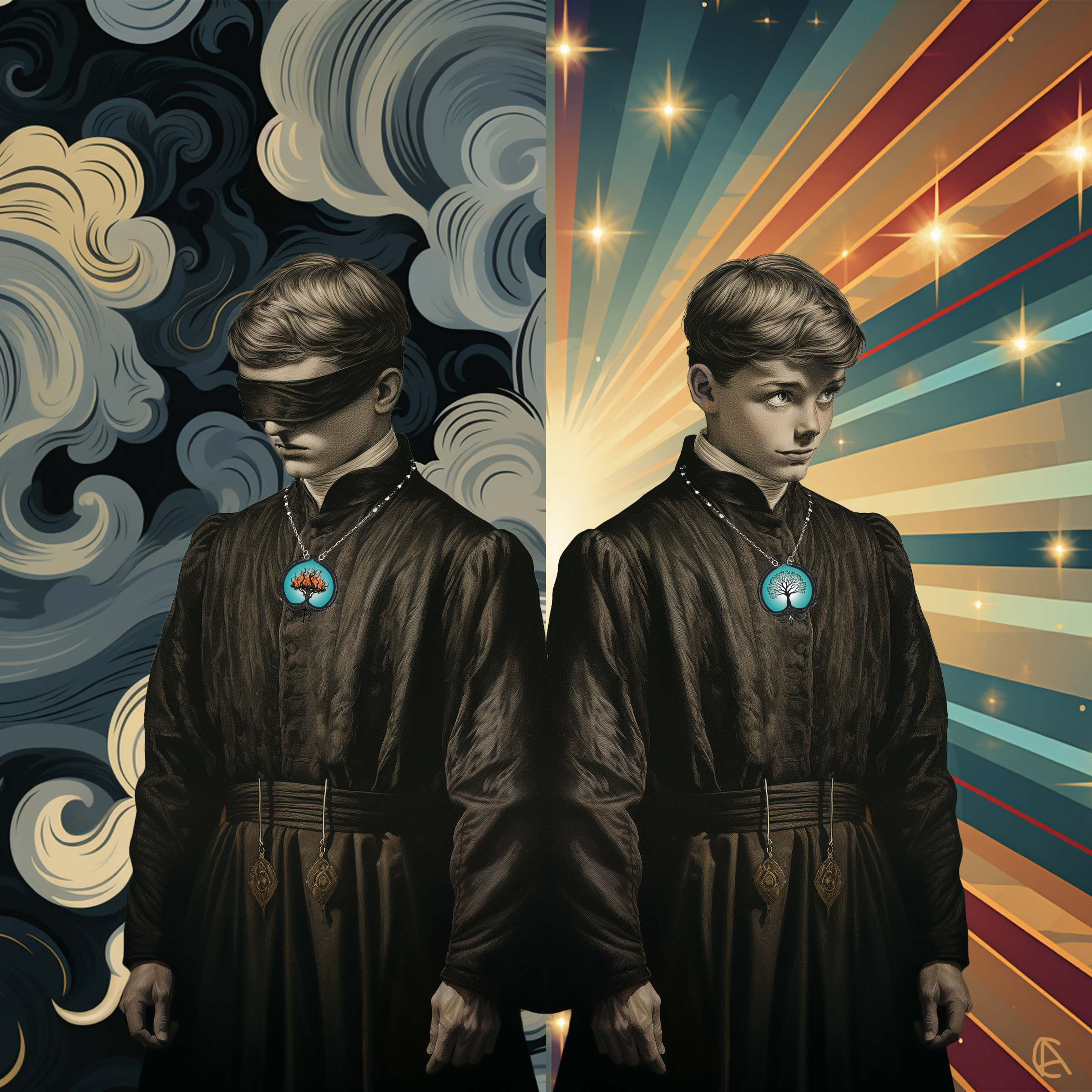
I depicted these concepts and thoughts with a dichotomy. On the left are those who are blinded by their own false beliefs. Though they think they can see, they are shrouded and masked. This inability to watch and look for truth adds to the miasma and “blindness” of smoke. The background then is waves of smoke. A pendant on the chain represents the sin that remains and leads to death.
In contrast, on the right are those awakened and now watch and look for the truth. The darkness and smoke clear as truth is found, and only light remains. This person’s chain has a pendant of the Tree of Life, representing eternal life.

Leave a Reply