
Job 7:4 NIV: When I lie down I think, ‘How long before I get up?’ The night drags on, and I toss and turn until dawn.
Next up in my series exploring different facets of anxiety is insomnia. Of all the ways anxiety presents, this one may be the most relatable. Even the book of Job, written thousands of years ago, records classic symptoms of insomnia. The literal meaning of this Latin-based word is “sleepless,” and it refers to a lack of sleep due to difficulty falling or staying asleep.
Medically, insomnia is a state of persistent hyperarousal in which the brain remains too alert to transition into normal sleep. Our bodies naturally balance chemicals that promote wakefulness with others that promote sleep. Anxiety tips that balance. The sympathetic nervous system releases chemicals designed to keep us awake, alert, and prepared for danger, exactly the opposite of what is needed for restful sleep.
Two common thought patterns often fuel insomnia: rumination and worry. Rumination looks backward, analyzing and rehashing the past, focusing on loss, regrets, and failures. Worry looks forward, focusing on potential dangers, problems, and what-ifs.
Whether stuck in the past or spiraling into the future, these thoughts trigger our nervous system, leading to a hyper-aroused state that prevents sleep. Then, to make matters worse, the awareness of our inability to sleep aggravates our anxiety because the lack of sleep itself becomes anxiety-provoking.
Oh, we’re not done yet, because compounding this is the fact that sleep deprivation impairs our prefrontal cortex’s ability to reason and be rational, and it increases our amygdala’s emotional reactivity.
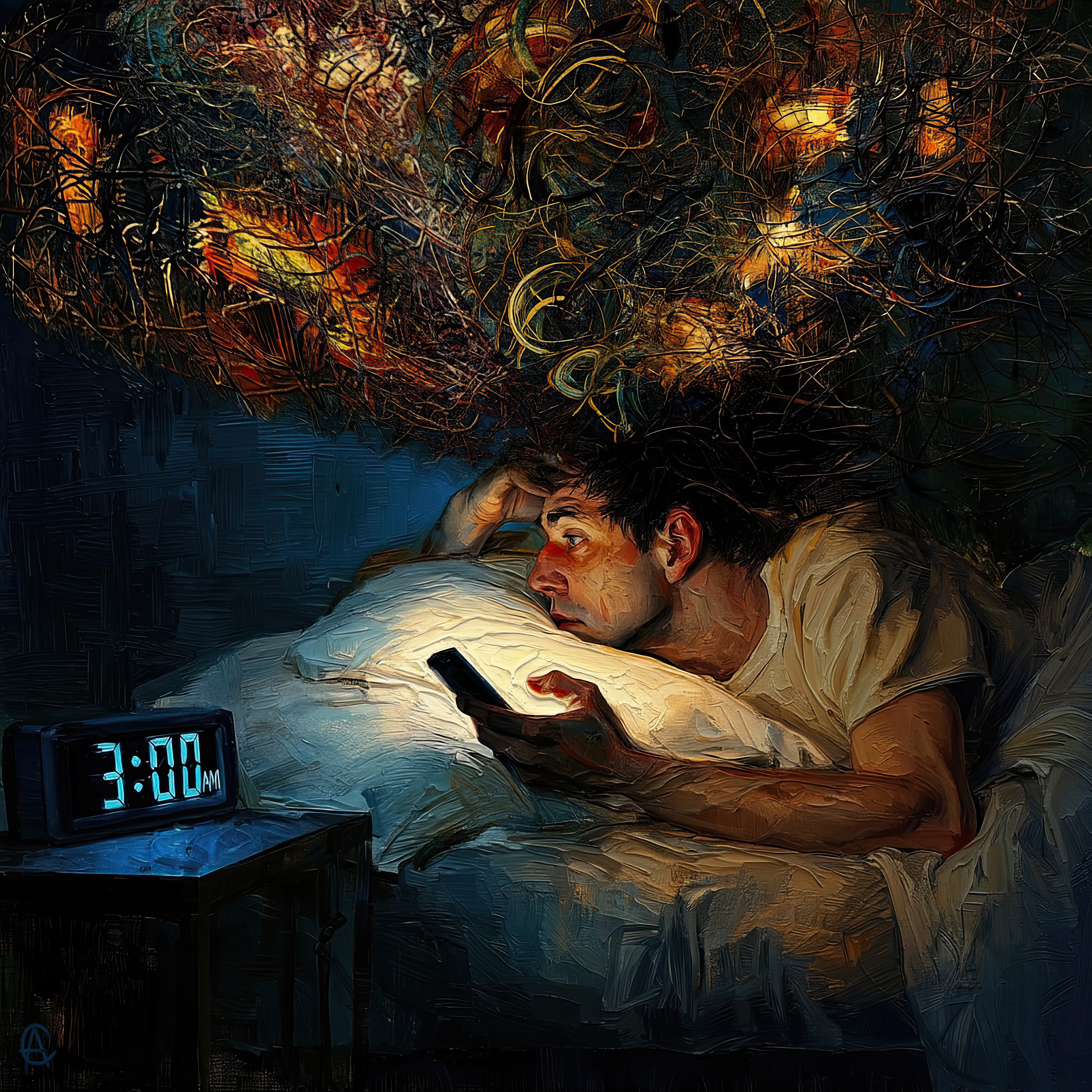
With the emotional volume knob turned up and the rational volume knob turned down, you can see why a stray thought can turn catastrophic at 3:00 am.
For my artwork, I wanted to convey the frenzied, tangled, and circuitous thoughts that wreak havoc on our sleep. Sometimes, when I stir, half-awake, a part of me holds its breath, hoping my mind won’t latch onto a single thought that throws every system into alert mode. “Don’t think, please, no thoughts, just let yourself drift back,” my mind whispers.
But eventually a single thought arrives. Then another. Soon the mind begins pulling on one loose thread after another until the entire tangled ball is set in motion again.
Interesting to note: the verse begins, “When I lie down, I think.” Job doesn’t blame the darkness or the bed. He points to his thoughts. Modern psychology would later name these patterns, rumination and worry, but Job had already described the experience thousands of years earlier.
They say 40-50% of us have experienced periods of insomnia. Have you? What have you found helpful?

Leave a Reply